
News
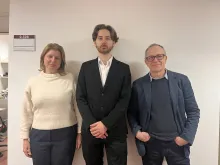
On January 22, 2026, Ármin Timár successfully defended his MSc thesis with an excellent (grade 5) result at the ELTE Faculty of Science, MSc in Geology program. His research was carried out within our research group, the MTA–HUN-REN CSFK Lendület "Momentum"; PannonianVolcano Research Group.
Title of the thesis: Timescales of Magma Reservoir Processes Based on Pyroxene Diffusion Chronometry. Application of Diffusion Chronometry to the Neogene Volcanic Rocks of Mátra and Tokaj Regions: Constraining Timescales Between Magma Recharge and Eruption
In one of the episodes of “Aktuál-földtudomány,” the joint podcast series of the Hungarian Geological Society and HUN-REN CSFK, the topic of volcanoes took centre stage. The guests of the discussion were Réka Lukács, head of our research group, and Szabolcs Harangi, senior member of the group.
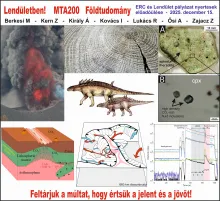
On 15 December 2025, as part of the Month of Earth Sciences celebrating the 200th anniversary of the Hungarian Academy of Sciences, a scientific session entitled “In Momentum” was held at the Academy. During the event, young researchers awarded with prestigious Lendület and ERC grants presented their latest findings and shared their professional experiences. Among the speakers was the head of our research group, who delivered a lecture entitled “From Magma Reservoirs to Volcanic Eruptions: Research in the Carpathian–Pannonian Region.”
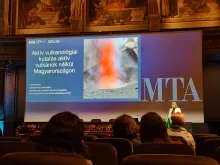
On 12 November 2025, as part of the Hungarian Science Festival series, the Hungarian Young Academy (FKA) organised a scientific lecture session. Among the speakers was Réka Lukács, Scientific Advisor at the HUN-REN CSFK Institute for Geological and Geochemical Research and head of our research group.
On 11 October 2025, to mark the Hungarian Geotope Day, János Szepesi organised a thematic hiking tour along the Blue Trail section between Mogyoróska and Háromhuta. The programme focused on introducing the volcanic rocks of the area and the geological processes associated with them.
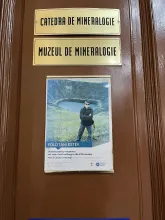
Representing our research group, Szabolcs Harangi gave an invited lecture in the “Geological Evenings” public lecture series at Babeș–Bolyai University, Cluj-Napoca, on 20 May 2025.
The title of the talk was:“Understanding volcanoes: the role of volcanology in the 21st century.”
The lecture addressed recent advances in volcanology, the scientific and societal relevance of volcano research, and the role of studies carried out on the volcanoes of the Carpathian–Pannonian Region.
On 26 May 2025, Szabolcs Harangi and Réka Lukács delivered invited lectures at the University of Bucharest within the framework of the GeoTalks seminar series.
Their presentations focused on the Neogene–Quaternary volcanism of the Carpathian–Pannonian Region and the magma reservoir system of Ciomad volcano.
The talks attracted considerable interest and were followed by lively discussion and excellent questions from the audience.
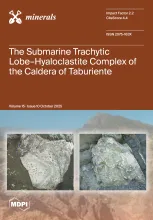
The submarine trachytic lobe–hyaloclastite complex of the Caldera of Taburiente (La Palma, Canary Islands) is the first lobe–hyaloclastite felsic complex to be described on an oceanic island in an intraplate setting. The felsic formation comprises three facies associations—(1) coherent facies: trachytic lobes with porphyritic, aphanitic, or glass trachytes; (2) autoclastic facies: hyaloclastites and autobreccias; and (3) syn-eruptive resedimented facies: mono- and polymictic breccias (massive or graded)—and volcaniclastic sandstones and breccias.
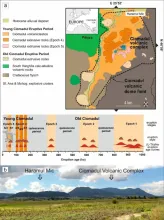
Our new paper has also been featured in the HUN-REN news.
We are very proud of this work and of its lead author, Emese Pánczél, who achieved this remarkable result while still an MSc student.
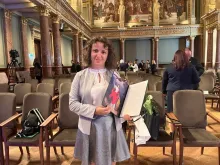
We are pleased to announce that Boglárka Mercédesz Kis ([link to her page]) has joined our research group, broadening the scope of our studies. With her expertise, our activities now also expand into the monitoring of volcanic gases, contributing to ongoing research on the Ciomadul volcanic area.
Starting this year, Boglárka also continues her work as a Bolyai Research Fellow, affiliated with the Department of Petrology and Geochemistry, Eötvös Loránd University (ELTE) and our group.