Volcano Day at Ciomadul in Szeklerland – we gave educational lectures
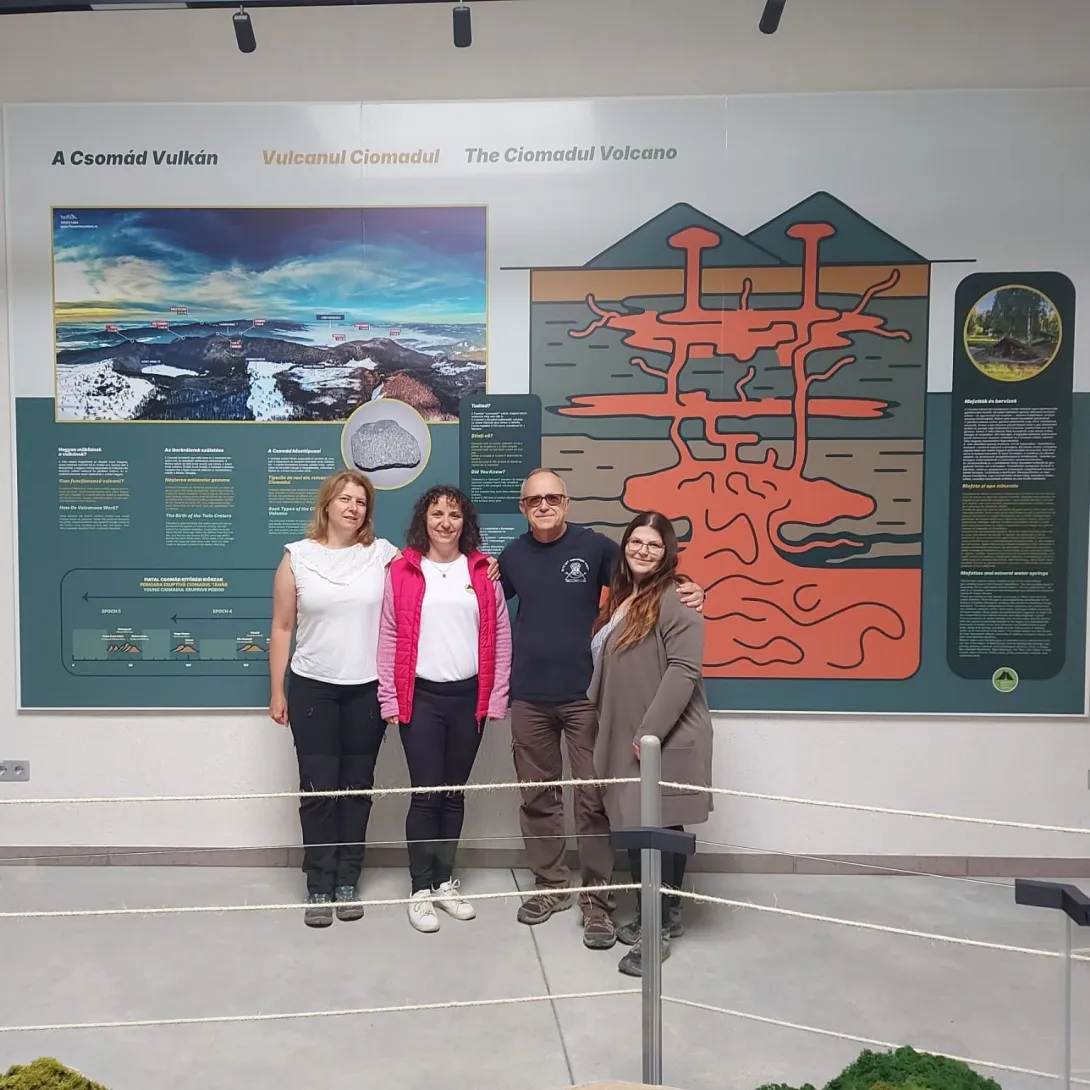
On June 1, the European Geoparks Network celebrates the International Volcano Day among geoparks. This provides an excellent opportunity not only to showcase the region’s outstanding volcanic natural heritage, but also to explain why and how volcanoes work and how awareness of this natural hazard can be increased. Some members of the research group have been conducting studies at Ciomadul already for two decades. Their research has contributed to the international recognition of the volcanic area located near Băile Tușnad (Tusnádfürdő) as a characteristic example of a long-dormant volcano. Among others this volcanological knowledge also provided a strong base and a supportive role in the development of an Education and Visitor Centre, blending harmoniously into the surrounding landscape on the saddle between Lake Szent Anna and the Mohos Peat Bog. In cooperation with Elek Levente Dósa, one of the leaders of the Szent Anna Common Ownership Association and the Pro Szent Anna Association, members of the research group also played an active role in creating the informative exhibition housed at the Education Centre.
The Ciomadul Volcano Day coincided with Children’s Day, attracting many families to the event. The program featured lectures, hands-on demonstrations, and volcanic eruption simulations. Réka Lukács, leader of the research group, shared the eruption history of Ciomadul with the large audience and also discussed what lies beneath the volcano. She explained how volcanic rocks, formed during past eruptions, preserve a wealth of information and demonstrated how a tiny mineral crystal, zircon, can reveal the history of the volcano and its magma reservoir. The story uncovered through this volcanological detective work was continued by Barbara Cserép, a PhD candidate researcher. She showed how the appearance and chemical composition of amphibole, one of the most common minerals in the Ciomadul volcanic rocks, provide valuable insights into the volcano’s past. Using these data, researchers have been able to determine the depths and temperatures at which the minerals formed, identify the location of a long-lived and extensive crystal-rich magma reservoir, and reconstruct the types of fresh magma injections that entered the system. These magma recharge events occasionally led to volcanic eruptions, and petrological research has also helped reveal the processes that triggered the eruptions.
Although the last volcanic eruption at Ciomadul occurred around 30,000 years ago, the area is still characterized by numerous carbon dioxide gas emissions and mineral water springs, locally known as borvíz. The local expert on these natural phenomena is Csaba Jánosi, who explained where and which types of mineral springs are found in this volcanic area and how local communities have traditionally used them. Boglárka-Mercédesz Kis, a researcher at the Institute of Geology, Babeș-Bolyai University and a member of the research group, has been studying carbon dioxide gas emissions in the region for more than a decade. Under her leadership, researchers have estimated that nearly 8,000 tonnes of carbon dioxide are released to the surface annually in the area. Results from isotopic analyses indicate that a large proportion of this gas is of magmatic origin. Together with geophysical and petrological evidence, these findings provide further support for the hypothesis that a magma reservoir with some melt fraction may still exist beneath Ciomadul. Boglárka also discussed the potential hazards associated with carbon dioxide emissions, highlighting the risks posed by the accumulation of this colorless, odorless gas in low-lying areas.
The talks held in the new Ecocenter attracted large interest, prompting the organizers to repeat the morning program in the afternoon. Between presentations, outdoor demonstrations took place, including the much-anticipated volcanic eruption simulations, which were particularly popular with children and families. During these demonstrations, Szabolcs Harangi, professor of the Department of Petrology and Geochemistry, Eötvös University, Budapest and member of the group, explained why and how magmas ascend through the solid crust and erupt, and what determines whether it will be explosive or lava-forming eruption. He discussed also the warning signs that may indicate an impending volcanic eruption and how communities can prepare for such events. He emphasized that there is abundant evidence from many regions around the world showing that magma can be stored within the Earth's crust for a prolonged period. While the presence of magma in the crust alone does not necessarily mean impending volcanic eruption and hazard, it underscores the importance of continuous monitoring, scientific research, and instrumental observations. In addition to simulating attractive explosive eruptions, similar as the last one in Ciomadul 30,000 years ago, Barbara Cserép and Szabolcs Harangi demonstrated how the lava domes of Ciomadul could form, illustrating how highly viscous magma slowly extrudes onto the surface and accumulates around volcanic vents. Boglárka-Mercédesz Kis and her students conducted field measurements using their instruments to determine how much gas was escaping from the soil, giving visitors a firsthand look at how volcanic gas emissions are monitored and studied.
The Ciomadul Volcano Day proved to be a great success. The organizers intended to establish a new tradition, with similar programs planned every year on June 1. The annual event will provide visitors with the opportunity to meet scientists in person and, through engaging and interactive activities, learn about the history of Ciomadul, its unique natural heritage, and how volcanoes work in general. By combining scientific presentations, hands-on demonstrations, and eruption simulations, the organizers aim to make volcanology accessible to a broad audience while raising awareness of the region’s remarkable volcanic landscape and its continuing scientific significance.
The Székelyhon also reported on the event: https://szekelyhon.ro/aktualis/mit-talalunk-a-szekelyfoldi-csomad-alatt-n-vulkandetektivek-valaszolnak